
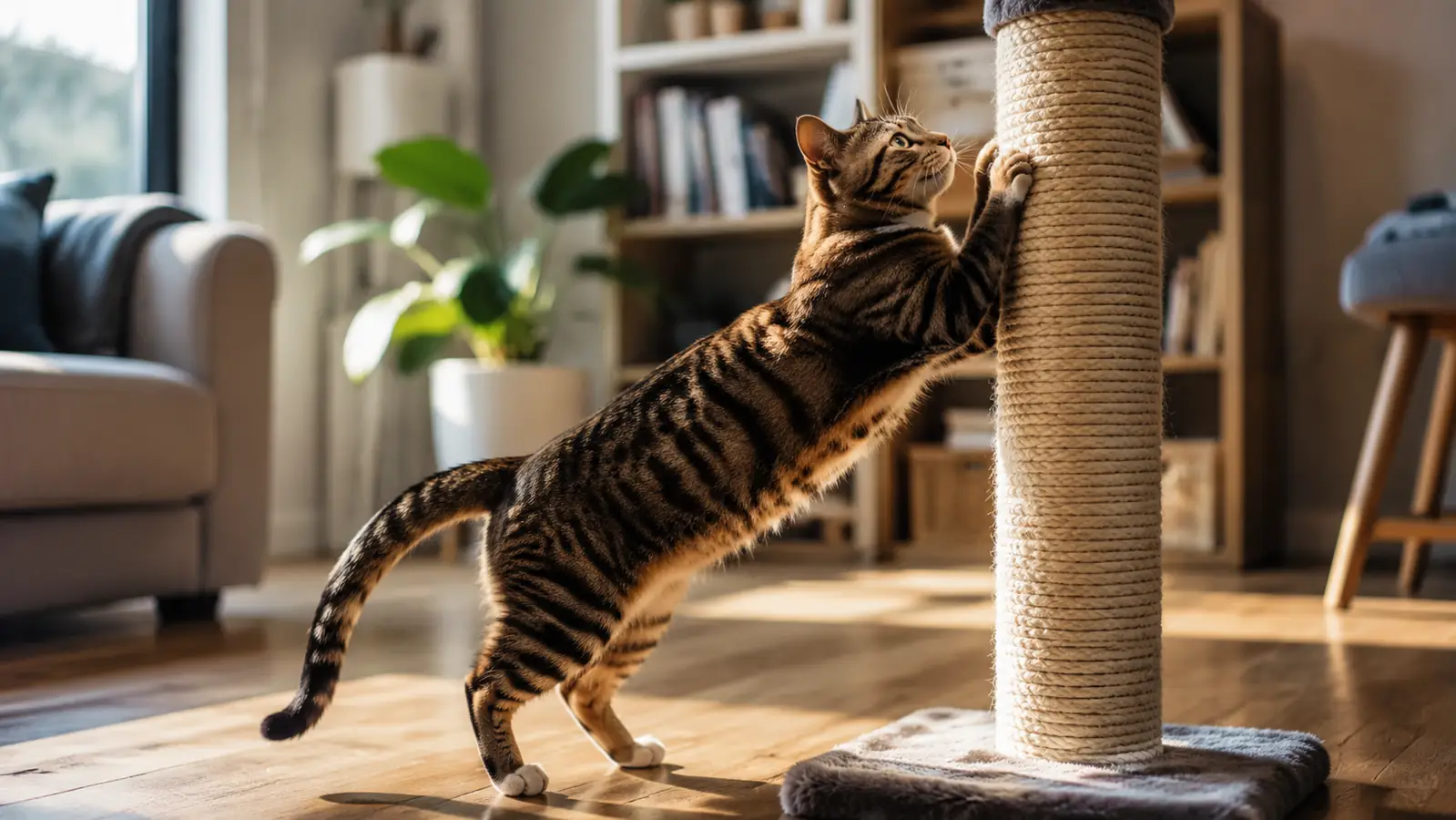
You have probably owned a cat and bought a scratch post, then watched the cat walk past it and go straight for the arm of the sofa. Scratch posts get a bad reputation for exactly this reason, because people set one down and let it do all the work. But scratching is a behavior with reasons behind it, and once you understand those reasons the post stops being ignored and becomes the obvious choice.
Cats scratch to shed the outer sheath off their claws, to stretch their shoulder and back muscles, to mark territory with the glands in their paws, and sometimes just because it feels good. It is not a spiteful act and it is not a bad habit you can train away. The goal is not to stop the cat from scratching. It is to steer the scratching to a surface you are okay with. That is the whole job, and it is more about placement and timing than it is about discipline.
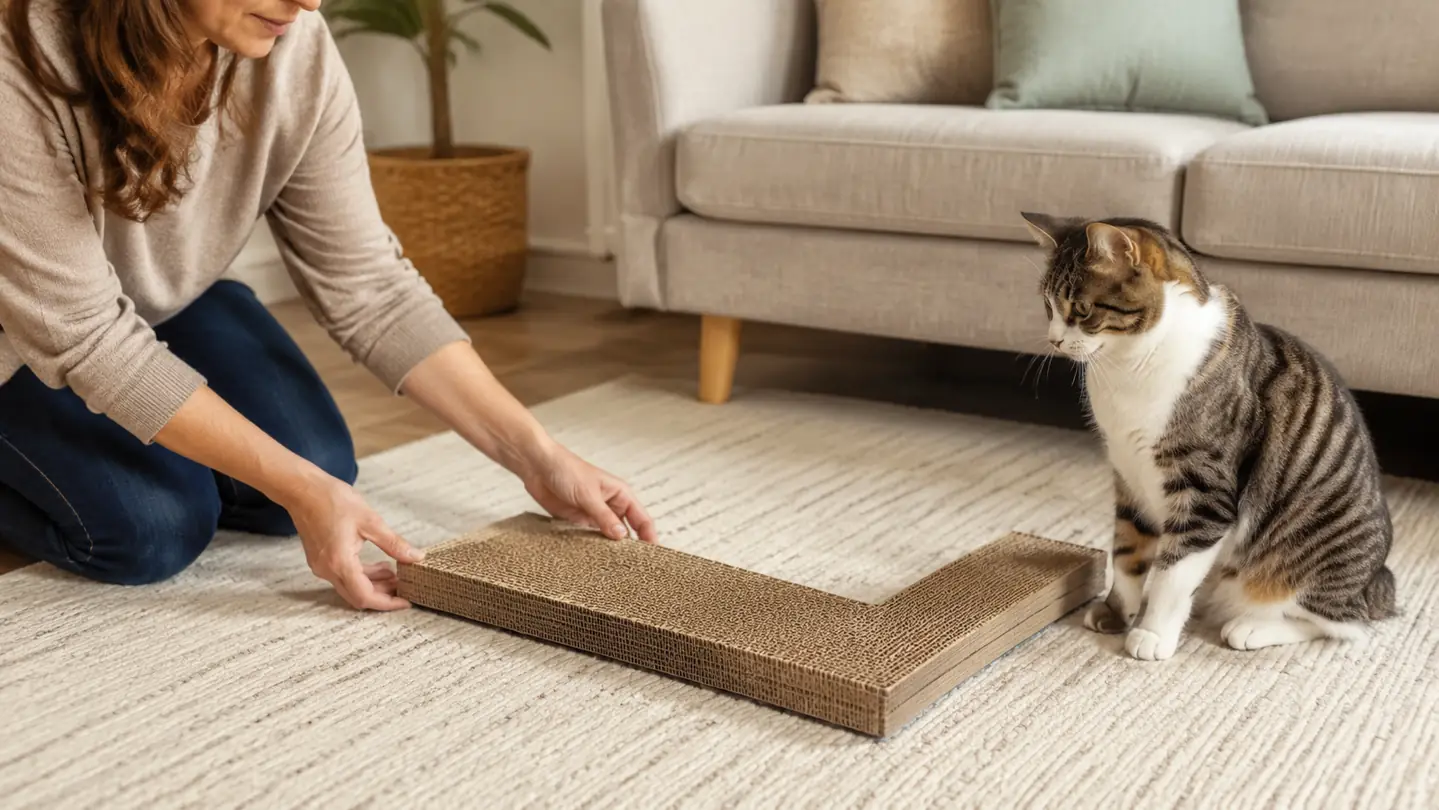
The scratch surface I keep returning to is the FUKUMARU cat scratcher. It is an L-shaped sisal cardboard pad, about 26 inches tall, with a small ball hanging from a string. What makes it useful for training is that it stands up on its own, which gives cats the full vertical stretch they prefer, and the cardboard texture is one cats take to quickly. The hanging ball is a small bonus, but the real work is the sisal surface. Before I walk you through the steps, here is the honest part: a good post helps, but the post alone does not do the teaching. The next few steps are where the actual result comes from.
Give the sofa a rival it can actually beat
The FUKUMARU L-shaped sisal cardboard post stands on its own, so it takes the full vertical stretch cats prefer. It is the surface I pair with the steps below, and it costs a fraction of a new sofa.
Amazon Check Today's Price on Amazon →Step 1: Put the post where the cat already scratches
Placement is the single biggest factor in whether a post gets used, and most people get it backwards. They put the post in a corner and hope the cat finds it. But a cat does not scratch where the human thinks it looks nice. A cat scratches where the cat already scratches, because scratching is about claiming a spot and leaving a mark on it, and that spot already smells like the cat.
So the first move is to put the post right next to the thing the cat is currently using. If the lip of the sofa is the target, set the post beside the sofa. If it is the bed frame or an armchair, place it there. Do not hide it in a corner. For the first few weeks the post should be out in the open, in the high-traffic path, because cats pick scratching spots where they feel confident and seen. Once the habit has moved, you can edge the post gradually toward a more convenient spot, a few inches a day. Move it all at once and the cat may start over on the sofa.
Place the post on a stable, non-slip surface. A post that wobbles or slides when the cat leans into the stretch will spook it, and a spooked cat stops using it. Put it on carpet or a rug if you can, so the base does not skate across a hard floor while the cat is pulling at the top. The FUKUMARU L-shape is low to the ground and stands on its own, which makes it easier to anchor in place than a tall tower that tips.
Step 2: Make the post the best option in the room
Cats choose one scratching surface over another for texture and stability, so you can quietly make the post the better deal than the sofa. Sisal and coarse cardboard are near the top of the list of what cats like to pull at. The FUKUMARU surface is exactly that, a dense sisal-coated cardboard with good give, the kind of texture most cats approve of on the first try.
Meanwhile, make the furniture less appealing without punishing the cat. Double-sided tape along the arm of the sofa stops that surface feeling good to dig into, and cats dislike the paw stickiness enough to look elsewhere. A scratch shield or a tightly fitted throw works too. The idea is not to make the cat miserable. It is to make the sofa a slightly unpleasant option next to an easy, satisfying one. When the choice is a sticky couch or a solid sisal post, most cats take the post.
Give the post a head start with scent. Cats mark with their paws, so rubbing a clean cloth over the cat's forehead or cheeks and wiping it on the post lays a scent trail that says this spot belongs to them. A light dusting of catnip along the base once a day for the first week works for many cats too, because it draws them to the post and gets them digging at it. It does not work on every cat, some cats are indifferent to catnip, so treat it as a nudge and not the plan.
Step 3: Get the motion started at the right moments
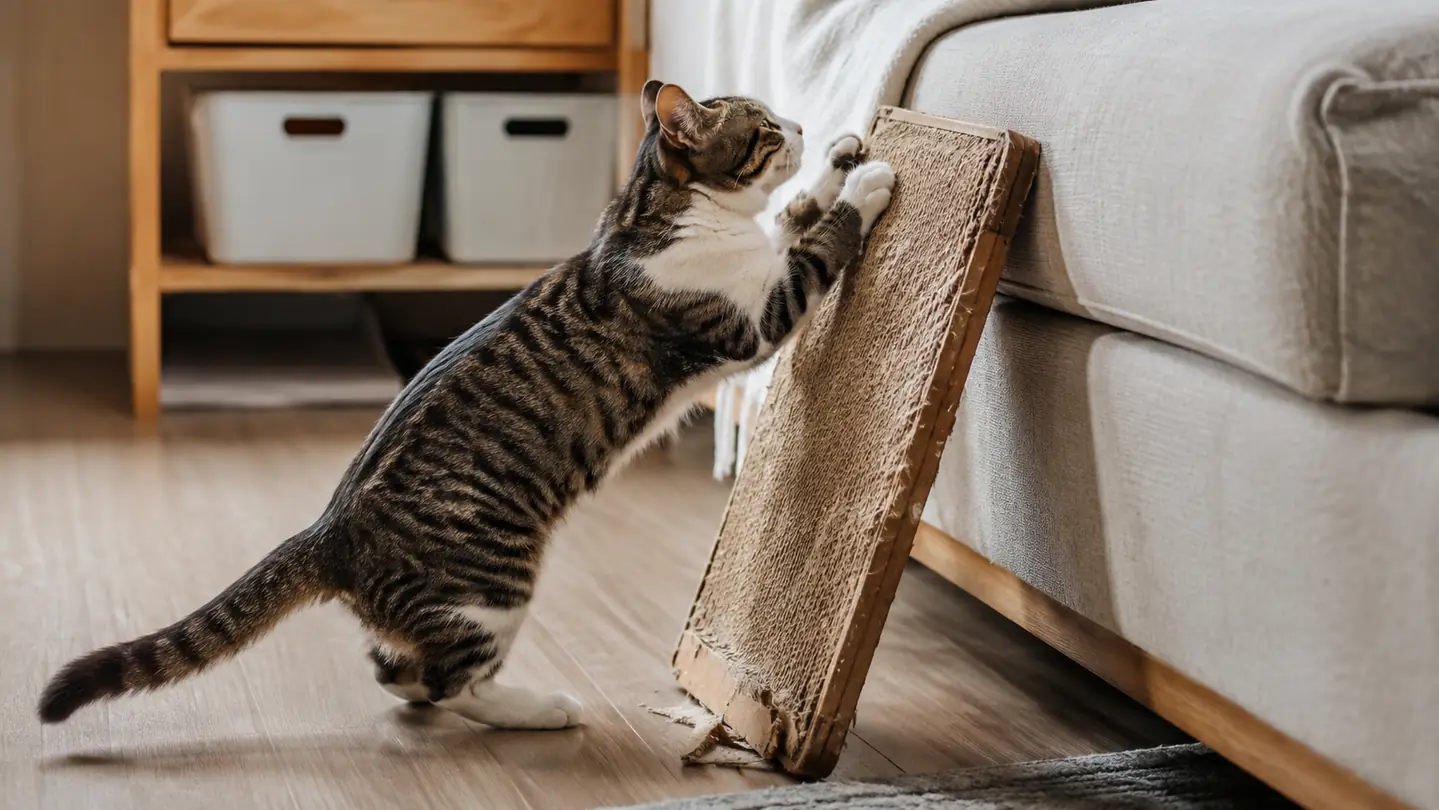
The most reliable cue to act on is the cat scratching where it should not. The second you see the claws go in on the sofa, that is the moment to redirect, because the instinct is already switched on and easy to move. Walk over calmly, pick the cat up if it allows it, and set it at the post. Then run your fingers or a wand toy down the surface of the post. The motion invites the cat to follow with its claws, and more often than not it will dig in right there.
Even better is to catch the cat approaching the post on its own and reward that. When you see the cat sniffing the post or giving it an experimental scratch, that is a win in progress. Give it a treat or a calm word in that moment, so the cat connects scratching the right thing with a pleasant result. Timing matters more than quantity. A reward delivered while the cat is actually scratching the post lands far harder than one given minutes later.
After sleep is another golden window. Cats scratch to stretch as they wake, so a post near a favorite nap spot catches that instinct on its way up. You will often see a cat rise, yawn, and immediately dig its claws into whatever is closest. If the closest thing is the post, you have won the routine without even trying.
The goal is not to stop the cat from scratching. It is to steer the scratching to a surface you are okay with, and that is mostly placement and timing, not discipline.
Step 4: Redirect instead of ever punishing
This is the step people get wrong and it is why some cats never come around. Yelling, clapping, spraying water, or pushing the cat off the sofa all make scratching more secretive, not less. A punished cat does not learn to avoid scratching. It learns to scratch when you are not watching, and it learns the sofa is a place where good cats scratch but stressy cats avoid, so the behavior goes underground and the furniture keeps getting damaged out of sight.
There is also a limit to how much you can steer a cat with timing alone, because a cat that is highly motivated, stressed, or simply very attached to a particular spot may keep returning to it for a while. That is normal and it is not a failure. Your job in that window is patience and consistency, not escalation. Every time you quietly move the cat to the post and reward the right scratch, you are building a new habit, brick by brick, and that takes days or weeks rather than minutes.
Keep the sessions short and positive. A training moment should last seconds, not a long struggle. If the cat resists being moved or growls, do not force it. Let it go, and try again next time. Forcing a cat breeds resentment, and a resentful cat is a much harder training problem than a simply uninterested one. Patience here is the whole game.
Step 5: Protect the furniture while the habit sets
While you retrain, cover the surfaces you are trying to save. A fitted couch cover, a throw you do not mind, or double-sided tape on the top edge of the arms will buy you the weeks it takes for the habit to move. It is far easier to protect the furniture for a few weeks than it is to persuade a cat away from a spot it has already claimed and marked. The moment the post becomes the settled routine, you can start removing the protection.
Also give the cat more than one legitimate option. Some cats want a vertical surface to stretch up and rake, some prefer a horizontal pad, and some want both depending on their mood. The FUKUMARU L-shape gives a vertical face with the low, stable footprint of a pad, which covers both impulses well. If you have multiple floors, consider a second surface on the other level, because a cat that lives upstairs and has a post only downstairs will use whatever is closest when the urge hits.
Watch the condition of the post. As the sisal cardboard gets worked, pieces will loosen and flake onto the floor, which is normal and expected. A scratched and slightly battered post is a triumphant sign that the cat is using it. Keep the surface engaging by tapping off loose bits and turning the pad if one side wears faster than the other. A post that is obviously used is exactly what you are aiming for.
What Else Helps
Scratching is partly a stress and energy outlet, so a cat that is bored or unhappy will scratch more and scratch harder at the things you least want it to touch. Regular play with a wand or toy, a couple of good out-of-breath sessions a day, and plenty of vertical space through cat trees or shelves all reduce the impulse to take it out on the sofa. An enriched cat scratches less often and aims at the right places more reliably.
If you try all of this and the cat keeps targeting one specific forbidden spot no matter what, consider what is different about it. The answer is sometimes texture, sometimes placement, and sometimes simply that the cat has claimed it thoroughly. When the surface is truly irresistible, the cleanest fix is to put an acceptable scratching surface directly in front of that spot and train the cat onto it. And remember that environmental stress, like a new pet or a disrupted routine, can spike scratching, so a sudden change in the habit is sometimes a signal to look at what changed in the household rather than at the post.
Watch for the health edge cases and defer to a vet on anything medical. If the cat is scratching obsessively at one spot, pulling out fur, biting at its paws, or scratching to the point of damaging skin, that can be a sign of a skin issue or an underlying problem, not just a training matter. Similarly, a sudden, intense change in scratching behavior can signal discomfort worth flagging. If paws look swollen or sore, or the behavior is relentless, that is a conversation for your vet, not another round of retraining. This guide is about habit, and it is not a substitute for a veterinarian's opinion.
Put the right surface in front of the cat today
The FUKUMARU L-shaped sisal cardboard post stands on its own, takes the vertical stretch cats need, and costs a small fraction of the furniture you are protecting. Pair it with the placement above and the habit follows.
Amazon Check Today's Price on Amazon →