
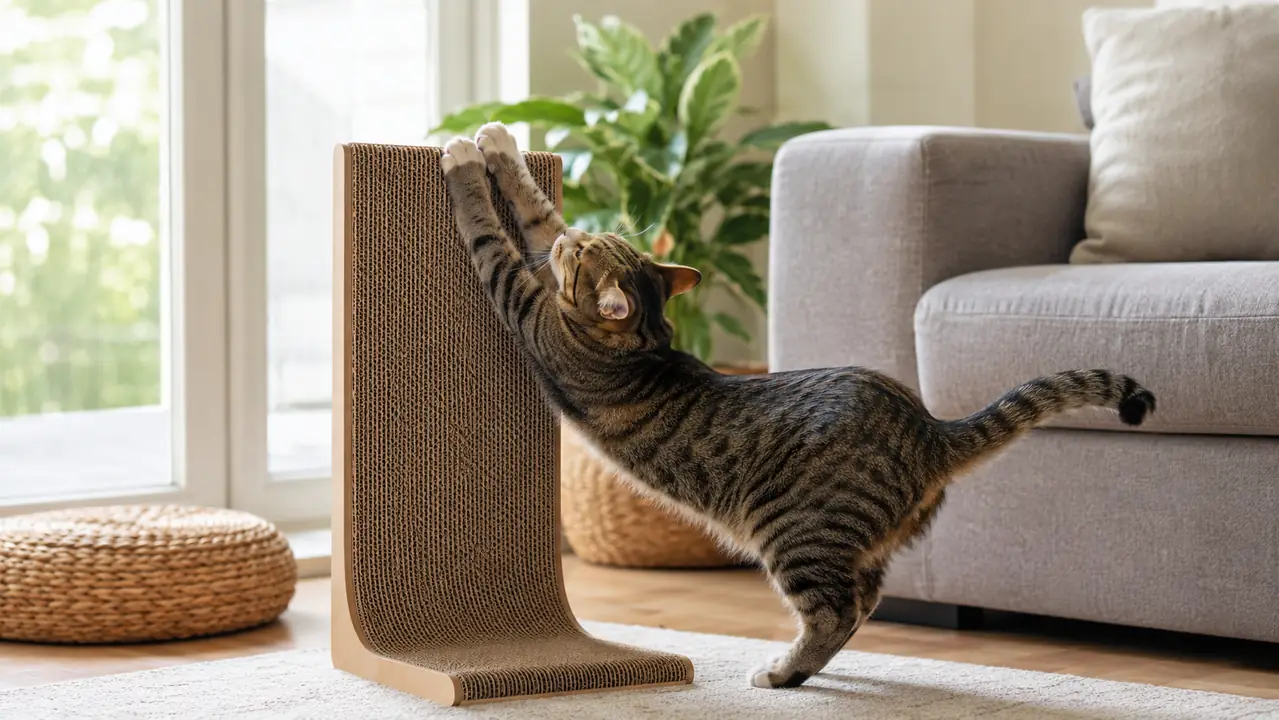
There is a stretch of sofa arm that looks exactly like shredded wheat, and you have started steering guests away from it. Every cat owner knows the drill. You try a spray, you try a cushion cover, you try wiggling a scratching post in front of the cat, and the cat thanks you by working on the opposite corner. The years I've spent around cats taught me what most of us learn the hard way: a cat does not scratch to be annoying. Scratching is something a cat is built to do, and the fix is not stopping the cat. It is giving the cat a better place to do it. A good cardboard scratcher like the FUKUMARU pulls the whole habit off the furniture and onto a pad you can replace for pocket change.
Here is the part most advice skips: it is not about owning a scratching post. It is about owning the right one, in the right spot. A post cats actually use protects the sofa. A post they ignore is just furniture in the corner. Here are ten reasons a cat scratching post saves your furniture, followed by an honest note on when it won't.
The L-Shaped Cardboard Pad Cats Actually Use
The FUKUMARU is an upright L-shaped cardboard scratcher with a little dangling ball, built for the vertical scratch cats prefer. It costs far less than replacing a sofa cushion cover. Check today's price before the couch takes more damage.
Amazon Check Today's Price on Amazon →It gives the claws a surface that actually takes the scratch
Soft furniture fabric is satisfying for a cat partly because it gives. Cardboard gives too, and it gives the way a cat wants: the fibers shred and roughen with every pass. When a cat sinks its front claws into the pad and drags down, it gets that same satisfying resistance and a clean result. The sofa no longer needs to be the thing that provides it.
It covers the tall, upright scratch cats prefer
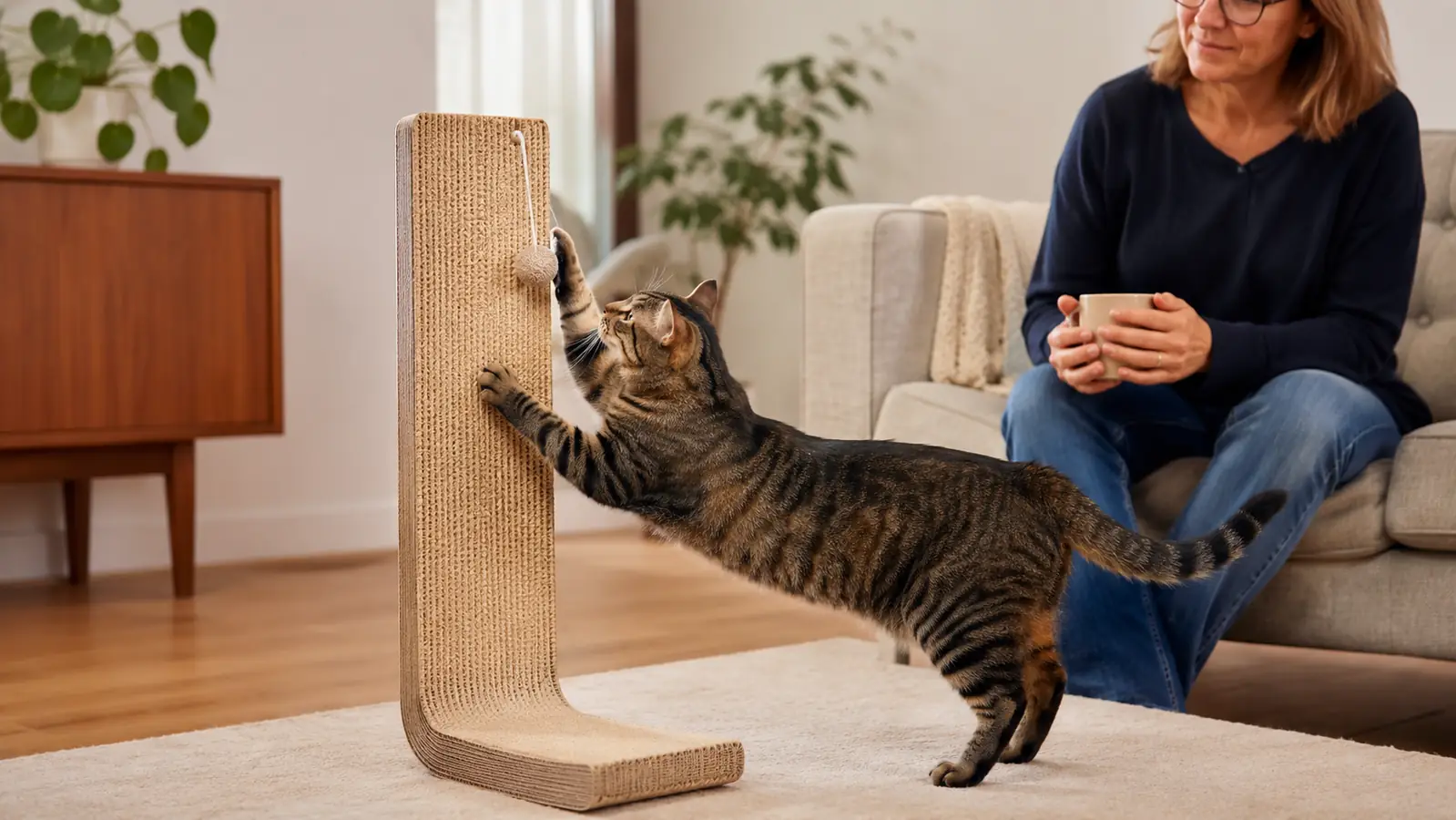
Most cats scratch while standing on their hind legs, reaching up, so they want something tall they can stretch against. Many cheap flat pads sit at floor level and never get touched for that reason. The FUKUMARU stands upright at roughly two feet tall, which matches the motion a cat makes against your couch arm. Matching the motion is half the battle.
The L shape catches the sofa corner habit
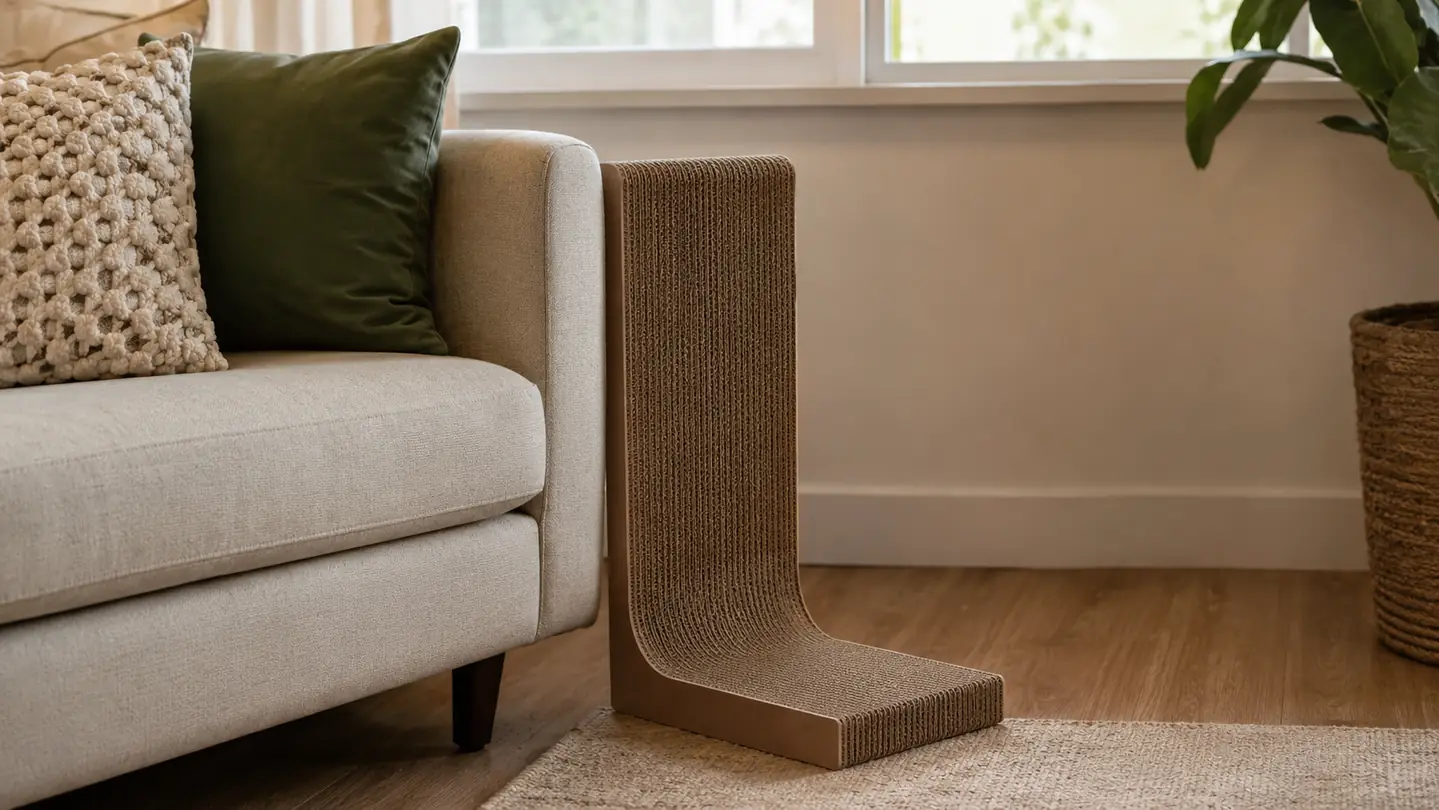
Cats love corners. They claim the edge of a doorframe, the corner of a box, the junction where the couch meets the wall. The L-shaped pad mirrors that corner shape, so a cat that is drawn to intersecting surfaces finds it naturally familiar. Instead of fighting every corner in the house, you hand the cat a corner of its own.
It collects the scent marking that would hit your furniture
Scratching leaves a cat's scent from pads, toes, and saliva, which is part of why they do it. The scent marks the spot as theirs. When that marking happens on the scratch pad near the couch, the message lands where you want it, and the couch stops being the object the cat is claiming. Give the pad the marking job and the sofa gets left alone.
It catches the after-nap stretch scratch
Watch a cat wake up. It stretches, and often it reaches for the nearest tall surface and scratches. That post-sleep scratch is clockwork, so the highest-traffic times for damage are right after naps and right after meals. If the pad sits next to the cat's favorite sleeping and eating spots, you are putting the post where the impulse already happens.
It handles the claw-keeping job the furniture would do
Scratching helps cats shed the outer layers of their claws, keeping them tidy. That maintenance still has to happen somewhere. If you give the cat a good rough surface, that job moves to the pad. This is normal cat behavior, not something to stop, but it is worth pointing the whole routine at the surface you are happy to replace.
The hanging ball turns it into the spot the cat already wants
Cats are attracted to movement. A little ball dangling off the top of the pad gives a cat a reason to approach, bat at it, and stay in the area. That proximity does the work for you: the more time a cat spends near the pad, the more the scratching happens there instead of on the furniture. A pad that entertains is a pad that gets used.
It is cheap insurance next to the cost of repairs
A ripped cushion, a frayed arm, a torn headboard, none of those repair themselves, and each of them costs real money. A cardboard scratcher costs a fraction of one cushion replacement. You can even buy a couple and place one in every room the cat actually uses. When the cost comparison is this lopsided, there is no real reason to gamble on the furniture.
It gives you a redirect instead of a fight
Scolding a cat for scratching rarely works, because the cat is not doing it to upset you. What does work is a redirect: when the cat starts on the sofa, carry it to the pad and let its claws find the cardboard. A stocked, nearby pad turns every correction into a simple move, and the habit shifts over a week or two instead of a season of frustration.
Cardboard wears well and costs nothing to replace
One honest advantage: you will scrape through the pad eventually, and that is the whole point. The shredded cardboard marks where the damage would have gone to your furniture. When a section wears out, you flip or replace the pad for a few dollars, and the sofa is exactly where it was. The scratch pad toasts while the couch survives.
What I'd Skip (and Which Cats Won't Use It)
Here is the honest part. A cardboard scratcher is not for every cat, and a pad that works for one household fails in another. Skip it if your cat claws almost exclusively on the ground, digging into rugs and mats with a horizontal drag. That cat wants a flat pad on the floor, not the upright L shape the FUKUMARU uses, so match the motion first.
The bigger limit is placement. A great post shoved in a back corner gathers dust while the sofa takes the beating. Put the pad where the cat already scratches and it gets used; put it where you think it looks nice and it gets ignored. And if a cat is scratching excessively, to the point the skin is red or bare, that is a reason to talk to a vet, not just to buy another scratching post. The FUKUMARU is a furniture saver, not a medical fix, and I would never pretend otherwise.
A cat does not scratch to be annoying. It scratches because that is what a cat does. Give it a satisfying place to do that, in the exact spot it already picks, and the sofa stops being the target.
Give the Cat a Corner It Actually Wants
The FUKUMARU L-shaped cardboard scratcher stands upright where cats scratch, hangs a ball to lure them in, and costs less than one cushion repair. Place it next to the couch and check today's price before the arm looks any worse.
Amazon Check Today's Price on Amazon →