
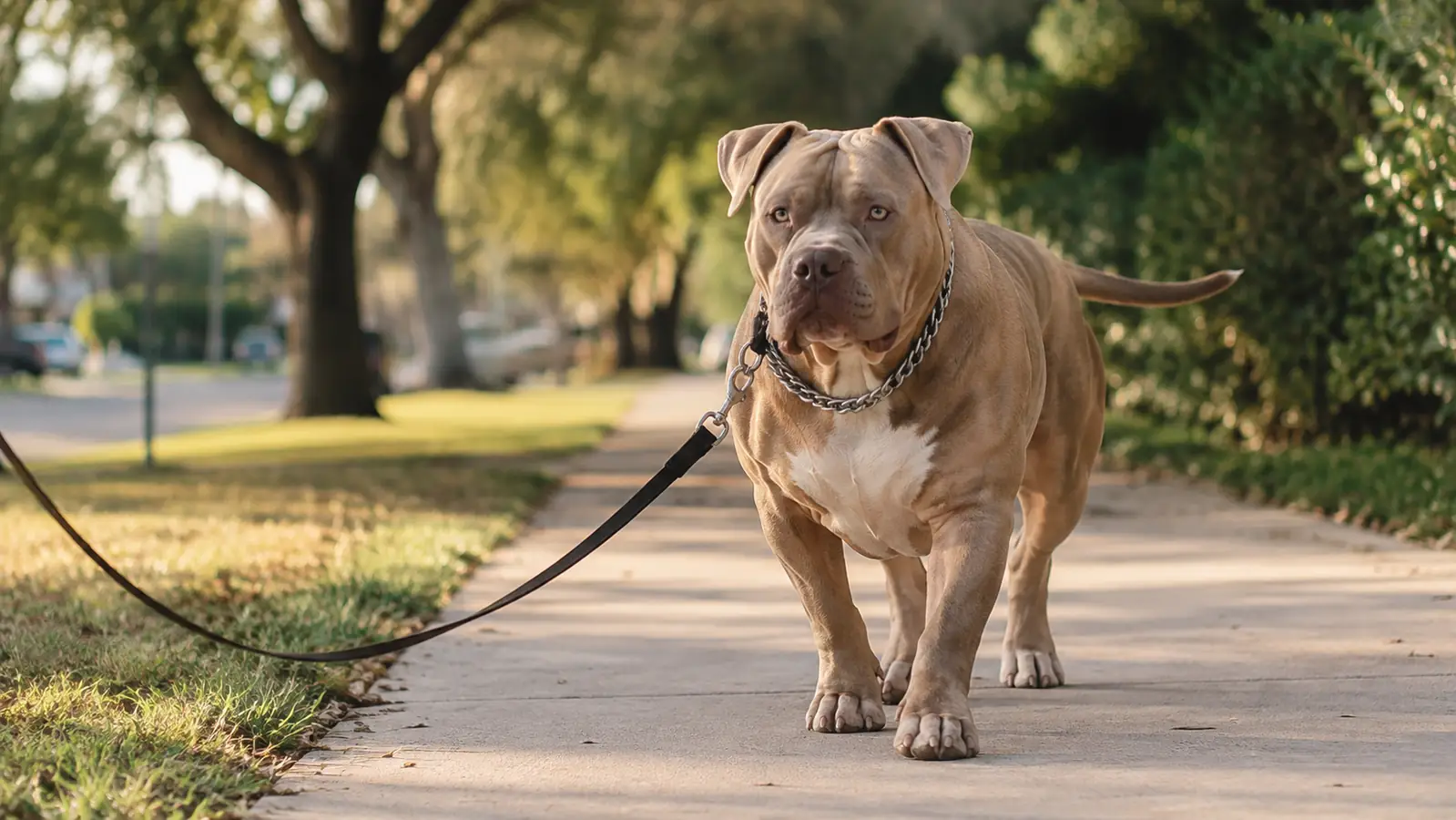
You know the walk. The dog is calm in the house, and the second the leash clips onto a collar the arms start. Squirrel, and you are pitching forward. Another dog, and you are bracing. By the end of the block your shoulder is burning and the collar has ridden up so high you start worrying about the dog's throat. You have tried the choke chain that changed nothing, the flat collar you could hear your dog coughing against, and a head halter that took about four minutes to scrape off on the first bush. The front-clip harness is the last sensible thing on the list, and it is why the rabbitgoo harness carries close to 200,000 customer reviews.
This is the follow-up to a longer six-week review I already wrote about this harness, the one covering the basics: how it goes on, whether the no-pull claim holds, and what it is like to live with. This piece is about the details the review count cannot show you. More than any harness I have used, this design lives or dies by fit, and fit depends on the specific dog underneath. The same harness on the same walk is a different product on a different body.
The Quick Verdict
A well-made front-clip harness that fixes most everyday pullers at a fair price. It only works when the fit is right, and no harness fixes every dog.
Amazon Check Today's Price →The fastest, least expensive fix for a pulling dog is a front clip. This is the harness I would start with.
It has held up through months of daily walks, the chest clip genuinely turns a lunging dog, and at today's price you are not gambling much to try it. The one thing you can get wrong is the size, so measure twice before you order.
Amazon Check Today's Price on Amazon →How I've Used It
For a few months now I have used this harness on a strong, easily distracted puller, the kind of dog that treats every parked car as a personal invitation and every yard with barking dogs behind the fence as a reason to forget you exist. Daily walks, morning and evening. The parking-lot walk at the vet, the trailhead walk, the sidewalk past the fence. That last one is where most walking gear goes to die.
I have also fitted the same harness on different body types to find out where it goes wrong, because a harness that fits one dog is almost useless on another. A deep-chested dog with a narrow ribcage. A stocky, barrel-chested dog. A lanky hound with a tucked waist. Same harness, noticeably different results, and the difference was never the harness itself. It was the shape underneath it.
One honest note before the details: I am not a trainer, and nothing that goes on a dog replaces training. What I can tell you from the years I have spent around dogs and cats is the mechanical part and the wear part. After months of daily use the buckles still click cleanly, the stitching at every adjustment point is intact, and the reflective trim still lights up at night, which is the first thing to fail on cheap harnesses. The foam padding has flattened a little where it crosses the ribs, so the harness reads slightly stiffer than new. The clips and rings and webbing are the strong part, and that is the ordering you want: the parts that hold the dog give out last.
Fit Is the Whole Story
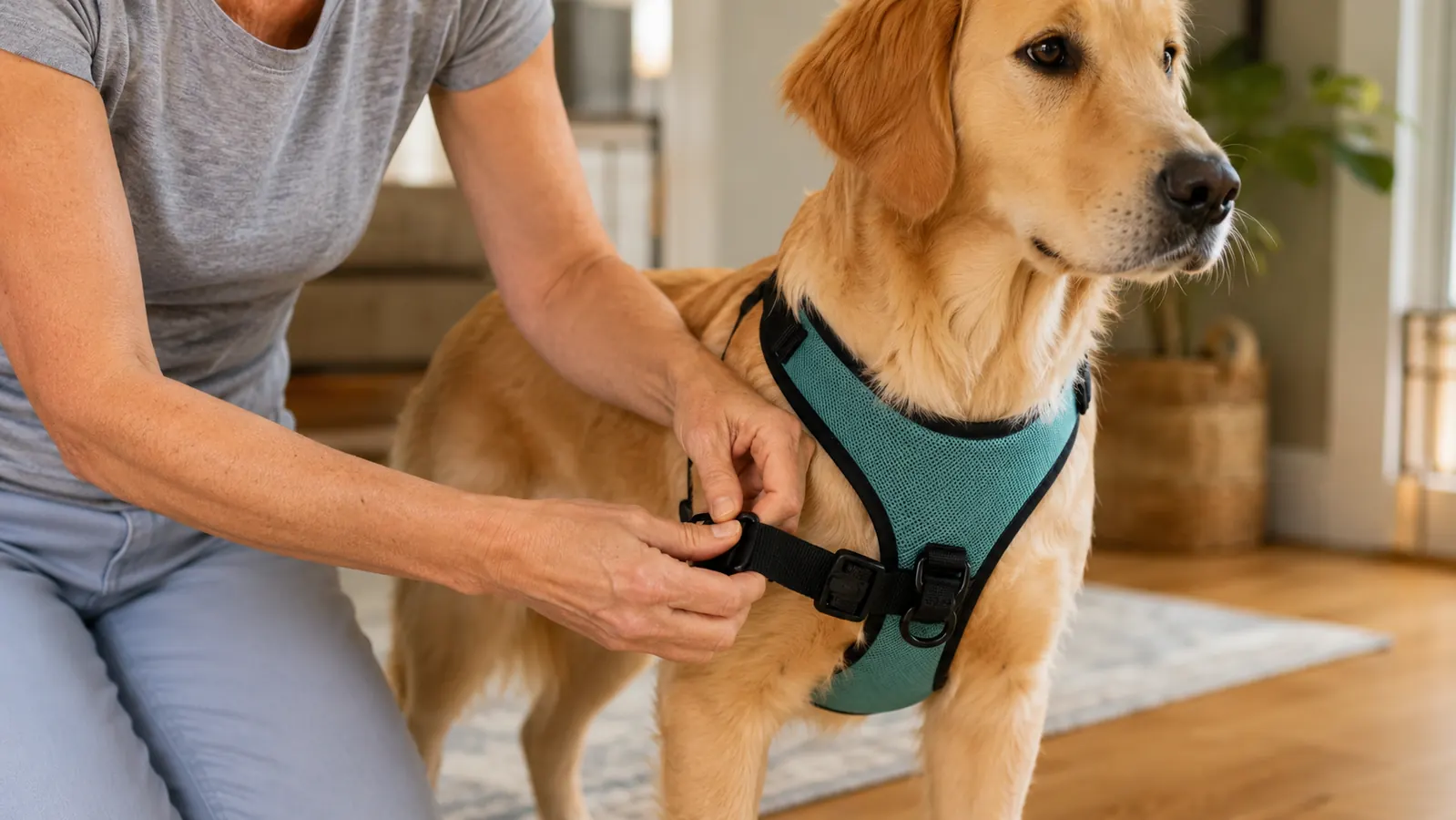
The rabbitgoo harness has two adjustment points, a strap across the chest and a girth strap around the ribs, and both clip together with buckles. What makes it good is the range. It genuinely fits a wide band of dog shapes, which is rare at this price, and it is the reason this product earned its review count. But the range is only useful if you set the length for your own dog, and most of the bad experiences I have heard about trace back to skipping that step.
The chest strap rides low, across the breastbone instead of across the throat. That is the design detail that makes the 'no choke' claim honest, and it is the first thing to check after you buckle it: you should be able to get the flat of your hand under the strap at the dog's chest, and a couple of fingers at the front of the neck. Nothing on this harness sits over the windpipe when it is adjusted like that.
The interesting part is what happens on different silhouettes. On a deep-chested dog the chest strap sits where it is supposed to, and the front clip hangs at the center of the chest, exactly where the redirect point should be. On a round, barrel-chested dog the same strap wants to slide forward toward the shoulders, and the clip drifts along with it, getting less effective. On a narrow-chested dog it can ride up toward the neck and the whole fit starts to twist. None of that is a defect in the harness. It is a fit detail, and the fix is learning where your dog's straps want to settle and snugging them down there, not setting them once and assuming they hold all week. Strap lengths also creep as a dog settles into wearing the harness, especially the girth strap, so re-checking before walks is a ten-second habit that prevents most of the mid-walk fidget complaints.
The underside of the front legs is the part that punishes a lazy fit. When the chest strap is too loose, or when you were between sizes and picked the bigger one for a dog that needed the smaller, the extra strap material bunches up behind the elbows and starts to rub twenty minutes into a walk. That is the most common comfort complaint in the review section, and it is a fit problem, not a design problem.
Measuring is a ten-second job and worth doing before you order. Wrap the tape around the widest part of the chest, right behind the front legs, with a couple of fingers of slack, and read the number. Compare it to the size chart, and if the chest measurement lands right on the seam between two sizes, the tiebreaker is the dog's build: a big neck and heavy shoulders push up a size, a narrow waist pushes down one. The number of buyers who order by weight alone and then fight the fit for a week is the true source of most of the angry one-star reviews.
Putting It On: The Part Everyone Skips
Dressing a dog that would rather be anywhere else is the hidden cost of any harness, and the rabbitgoo is middle of the road here. You drape it over the head, pass the clasp under the chest, and connect the buckles. For a calm dog it takes ten seconds. For the wriggly kind, the buckles are the fiddly step because they sit down under the body where you cannot see them, and you end up doing your first few fittings on a knee.
The handle on the back is the unsung feature. It is not there for looks: it gives you a place to hold when you need to pull a dog back from a curb, reposition the whole harness, or grab control in the parking lot without reaching for the collar. I use it every week, and it is the reason I would not trade down to a harness without one.
One more expectation worth setting straight: the first walk on any front clip feels wrong, because your dog suddenly steers sideways with every step. That is the harness working, not broken. Give it a week before you judge it. The first walk is the worst walk, and by day four or five the improvement is usually obvious.
What the Front Clip Actually Does to a Walk
Every front-clip harness works on the same idea. You clip the leash to the ring on the dog's chest, and when the dog surges forward the harness turns the front end sideways instead of letting the force run straight from the dog's body into your arm. The dog's own pulling becomes the thing that steers it off course. It is not punishment and it does not hurt. It just makes pulling inefficient, and dogs stop doing things that stop working.
What almost no review tells you is the side effect on the dog's stride. A dog pulling hard against a front clip does not walk in a perfectly straight line. It crabs a little, shoulders leading while the back end follows, because the point of control sits on the front. Most dogs adjust within a few walks and settle back into a normal gait. A determined puller, the sort that flings itself at every trigger, will move slightly sideways the whole time the front clip is on. I have watched that cause real worry in owners who thought the harness was hurting the dog. It is not. It is geometry, and it fades as the pulling fades.
The second ring, up on the back, is not decoration. It is the settle-down mode for a dog that has already learned a loose leash, and it gives a normal, straight stride without the crab. The honest way to use this harness is front to teach, back to enjoy. Start on the chest clip, and let the back clip be the reward as the pulling drops off.
What I Liked
- The chest clip genuinely turns a pulling dog without any pressure on the throat
- Two adjustment points that cover a genuinely wide range of body shapes
- Padded straps that have held up through months of daily use
- The top handle gets used every single week, more than I expected
- Reflective trim makes early-morning walks much more visible
- The back clip doubles as a real second mode, not a marketing line
Where It Falls Short
- Sizing takes real effort, and the wrong size will chafe under the front legs
- The chest strap can ride up and twist the fit on narrow-chested dogs
- A dog that wants out can still back out if the straps are not snug
- The front clip makes a strong dog walk slightly sideways at first
- Does not fix reactivity or extreme prey drive, and no harness ever will
The same harness is a different product on every dog it goes on. The difference is never the harness. It is the shape under it.
The Backing-Out Problem Is Real, and It Is a Fit Problem
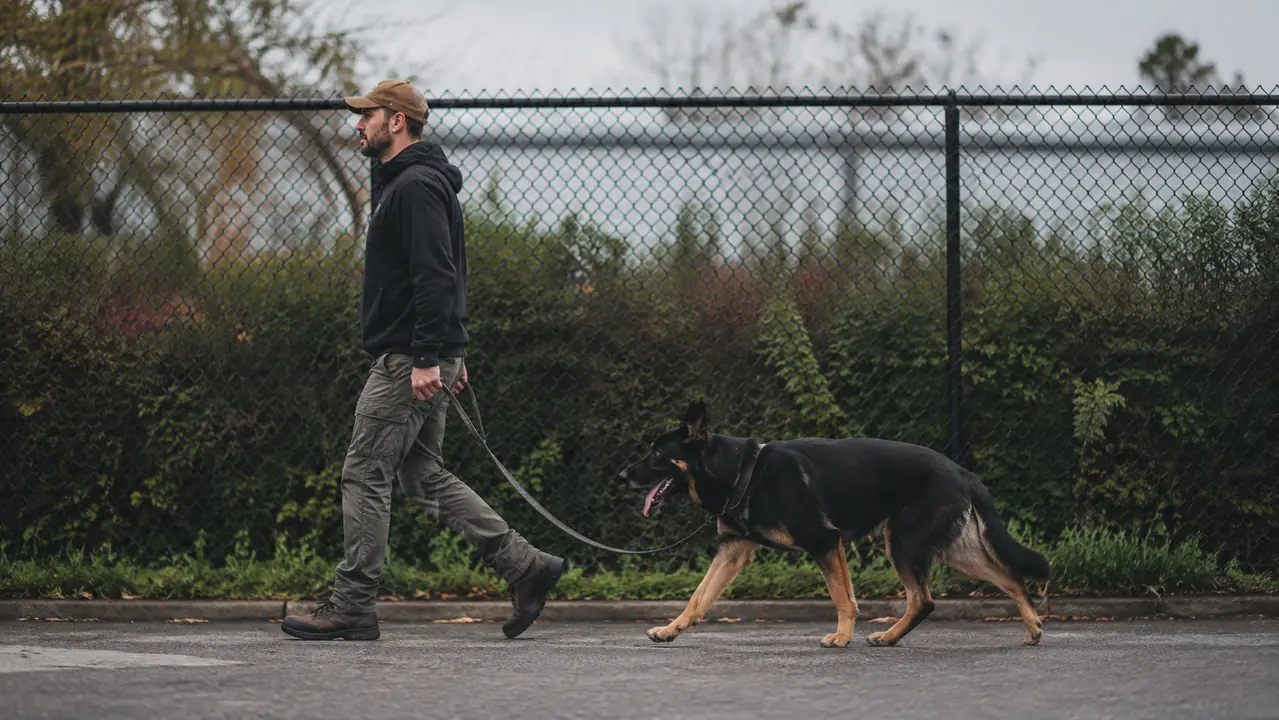
The most common complaint under any front-clip harness is the same sentence, over and over: 'my dog backed out of it.' It happens with this one, and it is almost always the fit, not the product. The chest strap, unless it is snug against the breastbone, hangs low on the dog like a loop it can step through. A dog that has decided it wants out has a window to pull one front leg back and slip it through the gap. The harness is not a cage. It assumes you fitted it for the shape in front of you.
The fix is mechanical, and it takes thirty seconds. The girth strap sits behind the elbows, not in front of them, and it is snug enough that you can just barely slide two flat fingers between the strap and the body. The chest strap gets the same check. For a dog between sizes, pick the tighter option within reason, because a loose harness is a harness a dog can learn to escape. And for a dog built slippery, a deep narrow chest with a tucked waist, check the fit twice as often, because that silhouette is exactly the shape the escape route wants.
One more thing about escapes: they almost always happen in the parking lot, not on the walk. The moment a dog is nervous, chest squeezing, it drops its front weight, and a loose strap gives it the opening it is looking for. If your dog flattens and retreats when it is scared, that is the dog most at risk of slipping a strap, so treat a nervous dog's fit as a live adjustment, not a set-and-forget one. And know this too: a dog that has ever succeeded at backing out will keep trying, because it worked once. Stay on top of the fit for the first few weeks until the habit fades.
The Dogs a Harness Like This Still Won't Fix
Here is the sentence I want attached to every checkout: a harness does not make a dog want to walk beside you. It removes the mechanical advantage of pulling. For most dogs that is enough, because the desire to move is already balanced by a little sense, and the dog just needed the leverage removed to notice. But there is a group of dogs where the pulling is a symptom, not a habit, and those are the dogs that leave people feeling like they bought a story.
A reactive dog, the one that explodes at other dogs or bikes or loud trucks, is over threshold, and a front clip does nothing against an adrenaline spike. A dog with real prey drive switches off at the sight of a squirrel, and for a few seconds no harness in the world holds a determined dog with weight behind it. And a dog that has pulled on a collar for years has strengthened its neck and shoulders for exactly that job; the harness takes the leverage away, and the dog will spend its first month testing whether the change is permanent.
If that is your dog, you do not have a product problem. You have a training problem, and the honest answer is a qualified trainer or a structured class, with the harness used as the tool inside the plan rather than the plan itself. The harness is a good tool. It is just not the whole course, and buying it expecting that is the fastest way to feel ripped off.
Who This Is For
The everyday puller. The healthy, excited dog that drags you to the fire hydrant, that is not aggressive and not terrified, that simply wants everything immediately. If your dog is basically trainable and you want the mechanical edge working for you while you do the training, this is the harness I would pick at today's price. Measure twice, live on the chest clip for the first few weeks, and let the back clip be the reward as the habit fades. It will not hurt the dog the way a choke collar can.
Who Should Skip It
Skip it if your dog sits squarely between sizes, or carries one of those shapes every soft harness slides off. Skip it if the real problem is reactivity or serious fear, because no harness fixes that and you will end up blaming this one. And skip it for a small dog that has escaped every harness you have tried, because those dogs usually need a stiffer shell or a deeper chest plate, not another soft vest. The front clip only pays off when the fit holds, and if the fit is questionable, the whole idea is questionable. When in doubt, fit the harness to the dog you have, not the dog in the listing photo.
If your dog is the everyday puller, this is the harness I would start with.
Fit it carefully and the chest clip does the redirecting while you teach a loose leash, and the back clip gives you a normal, straight walk once the habit fades. At today's price it is the easiest equipment upgrade a pulling walk offers. What it will not do, no harness can, and now you know where that line sits.
Amazon Check Today's Price on Amazon →